Caring for the Caregiver: Why Self-Care Matters for Frontline and Helping Professionals

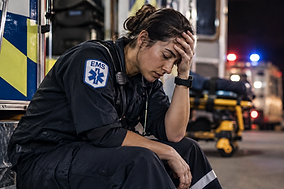
People who work in EMS, policing, firefighting, healthcare, and counseling spend their professional lives supporting other people through some of the most difficult moments of their lives.
They respond when others are having their worst day. They make decisions under pressure, absorb other people's distress, manage crises, and often continue working long after their own nervous system has been asked to do more than it was designed to sustain.
The ability to keep showing up is a strength.
But strength without recovery can eventually become depletion.
Self-Care Is More Than Taking a Day Off
For helping professionals, self-care is sometimes reduced to familiar advice: exercise, eat well, get enough sleep, take a vacation, or find a hobby.
Those things matter. But sustainable self-care goes deeper.
It involves developing the awareness and life skills necessary to recognize what is happening internally and respond before stress becomes overwhelming.
This can include learning to:
- Recognize early signs of stress, overload, and emotional exhaustion
- Understand personal limits and establish healthy boundaries
- Develop effective ways to regulate stress and recover after difficult experiences
- Maintain meaningful relationships and social connection
- Make space for rest without feeling guilty about it
- Identify values and priorities outside of work
- Navigate major life transitions
- Develop healthier responses to difficult emotions
- Recognize when additional professional support may be appropriate
- Create routines that support long-term physical, emotional, and mental wellbeing
Self-care isn't about becoming perfectly balanced.
It's about developing the capacity to notice when the balance is shifting and make adjustments.
The Culture of Helping Can Make Self-Care Difficult
Many people are drawn to helping professions because they genuinely care about other people.
That same orientation can make it difficult to turn that care inward.
Frontline culture can also reinforce ideas such as:
"Just keep going."
"Other people have it worse."
"This is part of the job."
"I don't have time to deal with my own stuff."
"I'll deal with it when things slow down."
The problem is that things don't always slow down.
Repeated exposure to emergencies, suffering, trauma, responsibility, conflict, and emotional intensity can accumulate. Sometimes the effects are obvious. Sometimes they appear more subtly through irritability, exhaustion, withdrawal, sleep disruption, difficulty relaxing, loss of connection, or simply feeling that life has become harder to manage.
And helping professionals aren't immune simply because they understand mental health.
Knowing what someone should do and having the capacity to actually do it are two different things.
Why Life Skills Coaching Can Help
Life skills coaching can provide a space that is different from the traditional clinical model of mental health treatment.
Coaching is not a replacement for psychotherapy, medical care, or crisis support when those services are needed. Instead, it can complement them by focusing on the practical side of living well.
For a frontline or helping professional, that might mean working together to identify:
What is actually important to me right now?
What do I need in order to recover?
Where am I consistently overextending myself?
What boundaries would make my life more sustainable?
How do I create a life that isn't entirely organized around my profession?
What happens when I finally have time to slow down?
These aren't necessarily clinical questions. They are life questions.
And sometimes having a dedicated space to explore them can make a significant difference.
From Surviving the Job to Building a Life
One of the challenges of helping professions is that work can become an identity.
You may be a paramedic, firefighter, police officer, nurse, physician, counselor, therapist, or other helping professional—but you are also a whole person outside that role.
You have relationships, interests, values, physical needs, emotional needs, aspirations, and a life that exists beyond the uniform, badge, hospital, clinic, ambulance, or office.
Life skills coaching can help create space to reconnect with those parts of yourself.
That might involve developing a healthier relationship with work, preparing for a career transition, rebuilding routines after burnout, improving communication and boundaries, exploring purpose, or simply figuring out what you want the next chapter of your life to look like.
You Don't Have to Wait Until You're in Crisis
One of the most important aspects of mental health maintenance is that support doesn't have to begin when something is seriously wrong.
We service equipment before it fails.
We train before the emergency happens.
We maintain vehicles, medical equipment, protective equipment, and systems because prevention is part of professional responsibility.
Our mental and emotional wellbeing deserves the same consideration.
Seeking support isn't an admission that you're incapable of doing your job.
It can be an investment in your ability to continue doing the things that matter to you—while also having a life that matters when you're not working.
Caring for Yourself Is Part of Caring for Others
People in helping professions often enter their careers because they want to make a difference.
That doesn't require sacrificing yourself in the process.
Sustainable service means recognizing that you are part of the equation.
Your wellbeing matters.
Your relationships matter.
Your identity outside of work matters.
Your ability to rest matters.
And your life after the shift matters.
Self-care isn't selfish. It is one of the foundations of sustainable service.
Life skills coaching can offer a practical, non-judgmental space to step back, take stock, and build the skills needed to create a life that supports the person behind the profession—not just the professional who supports everyone else.
You spend your career helping others. You deserve support in building a life that helps you, too.
Life skills coaching is not a substitute for professional mental health treatment. If you are experiencing significant psychological distress, thoughts of suicide or self-harm, or other mental health concerns requiring clinical care, seek support from an appropriately qualified healthcare or mental health professional.
Comments